
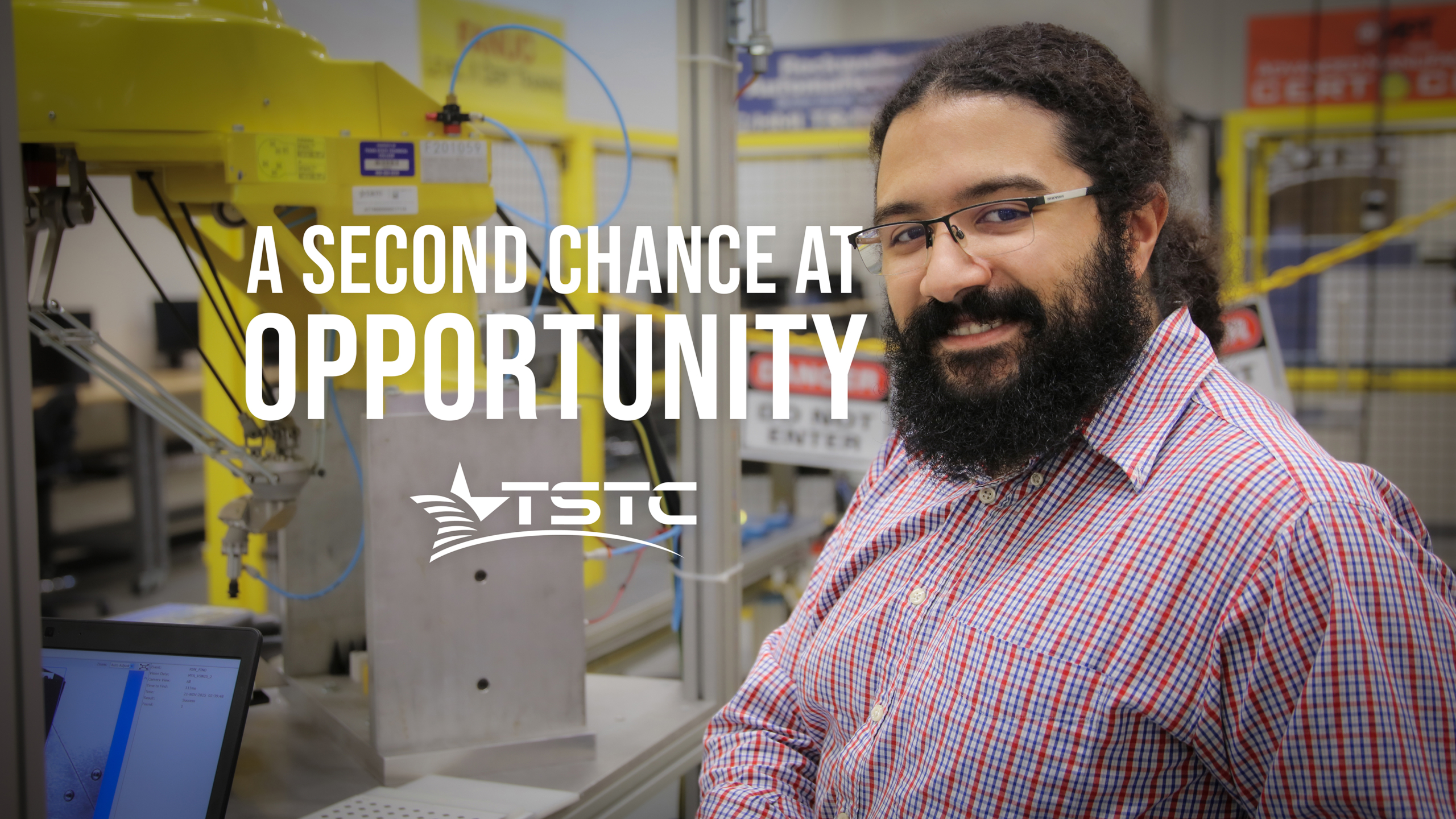
Muhammad Yasin Abduwaheb knows what it is like to uproot everything he knows for a chance at a more fulfilling life. And he would take that chance every time. Today, he is thriving in the Robotics and Industrial Controls Technology program at Texas State Technical College. But the road that brought him there stretched across continents, career setbacks, and moments of deep uncertainty.
A dream is neither quickly nor easily achieved. But it does pull you forward, urging you through the weeds and thorns until you emerge to a beautiful vista.
Muhammad’s story spans two countries. Born in California, he moved with his family to Egypt at age four, where he grew up, attended school, and worked part-time jobs. As a dual citizen, he learned early on what it meant to adjust to new environments and navigate major life changes.
After high school, Muhammad’s options began to narrow. Having been part of the Al-Azhar school system—and with encouragement from his parents—he enrolled at Al-Azhar University. His grades and the programs available led him to pursue a degree in agricultural sciences with a focus on poultry production.
But the field he studied wasn’t where his passion lived—a realization that would later make his experience at Texas State Technical College especially meaningful.
“I’m grateful for the Al-Azhar school system because they taught us how to open up with different faiths, how to talk to people, how to have a little bit of philosophical understanding,” Muhammad said. “But after I got my degree, there was a lot of uncertainty.”
A Decisive Decision
After graduating from college, Muhammad struggled to find steady work in agricultural sciences. Jobs in his specialty—poultry production—often required long stretches in remote areas, making it difficult to build a stable life. With little certainty in the field, he accepted a landscaping consultant position at Arab Consulting Engineering, where his father worked.
Although the job was unrelated to his degree, Muhammad put in the effort to learn, take courses, and work his way up. But advancement required connections and resources he didn’t have, and the stability he’d managed to build eventually faded. His father’s passing, combined with a difficult economy, made self-sufficiency even harder. He began to feel he was forcing himself into a path that didn’t fit.
With only a brief childhood visit to the U.S. as reference, Muhammad made the decision to return, hoping for a fresh start—a decision that would eventually lead him to Texas State Technical College, though he didn’t know it yet.
“I had to find out what was on the other side,” he said. “What were the opportunities? What were the possibilities?”
Determined to move quickly, he searched for the most affordable way to get there, booked the cheapest flight he could find, and within four days was on a plane to Houston. He jokes now about having no real plan, but at the time he was ready to face whatever came next. A half-brother already living in Texas helped him get settled, and the state itself felt like a symbol of possibility.
“Texas is like the loud voice of America in a sense,” Muhammad said. “You think about ranches, cowboy hats, trucks. You also think about strength. Everything I wanted seemed to be aligning toward Texas.”
A Life Worth Living
But moving didn’t mean everything suddenly fell into place for Muhammad. His degree from Egypt still wasn’t helping him land a job, and he found himself back in the cycle of job hunting. During this challenging period, he met his future wife and her family.
Muhammad views his wife as his greatest source of inspiration—from the day they met to the present. Despite coming from different backgrounds, they formed a strong connection and encouraged each other to pursue their dreams.
“I have never seen a person who sees the good in people as much as she does,” Muhammad shares. “She saw right through the struggles I was facing. She didn’t see just the end results or the conditions that I was in; she saw the potential in me.”
As their relationship became more serious, Muhammad met her parents, whom he now considers like his own. Understanding that he never had a say in what he studied during college—and how much that influenced his outlook—they asked him what he would have chosen if he’d had the chance.
His answer came quickly: robotics.
One of his summer jobs growing up was working in a computer mall fixing electronics and gadgets. It was one of the most stimulating jobs he had, and he realized that much of what he learned about how computers functioned helped him navigate some of his own challenges.
He saw the way machines communicated as a kind of puzzle. As he learned how to adjust different functions and understand the cause and effect in programming, he began to better understand how he himself operated and interacted with others and the world around him.
His now mother-in-law had spent 32 years as a school counselor for Fort Bend ISD, and she reached out to former coworkers about possible degree pathways in robotics. She was advised to look into Texas State Technical College, and Muhammad went for a tour. As he recalls it, the moment he saw the yellow robotic arms inside the robotics lab on TSTC’s Fort Bend County campus, he knew he was in the right place.
Since that day, Muhammad has been studying in the program, learning everything he can about a career he truly enjoys. He married his wife in February, and with her support, he has been able to attend school while working only part-time. Now just one semester away from graduation, he has already begun searching for jobs—and even has a promising offer in hand.
“I don’t take what I have here for granted,” Muhammad said. “I’ve been very grateful for all of this. A piece of advice I’ve taken to heart is that if you see some sort of road that’s a little bit off-road, that it’s better than the smooth highway you always drive on. If it piques your interest, you should always go for it.”
Graduates of TSTC’s Robotics and Industrial Controls program have gone to work for companies such as Mayekawa and JLL. Graduates who don’t receive a job offer within six months of graduation are refunded their tuition according to the college’s Money-Back-Guarantee.