
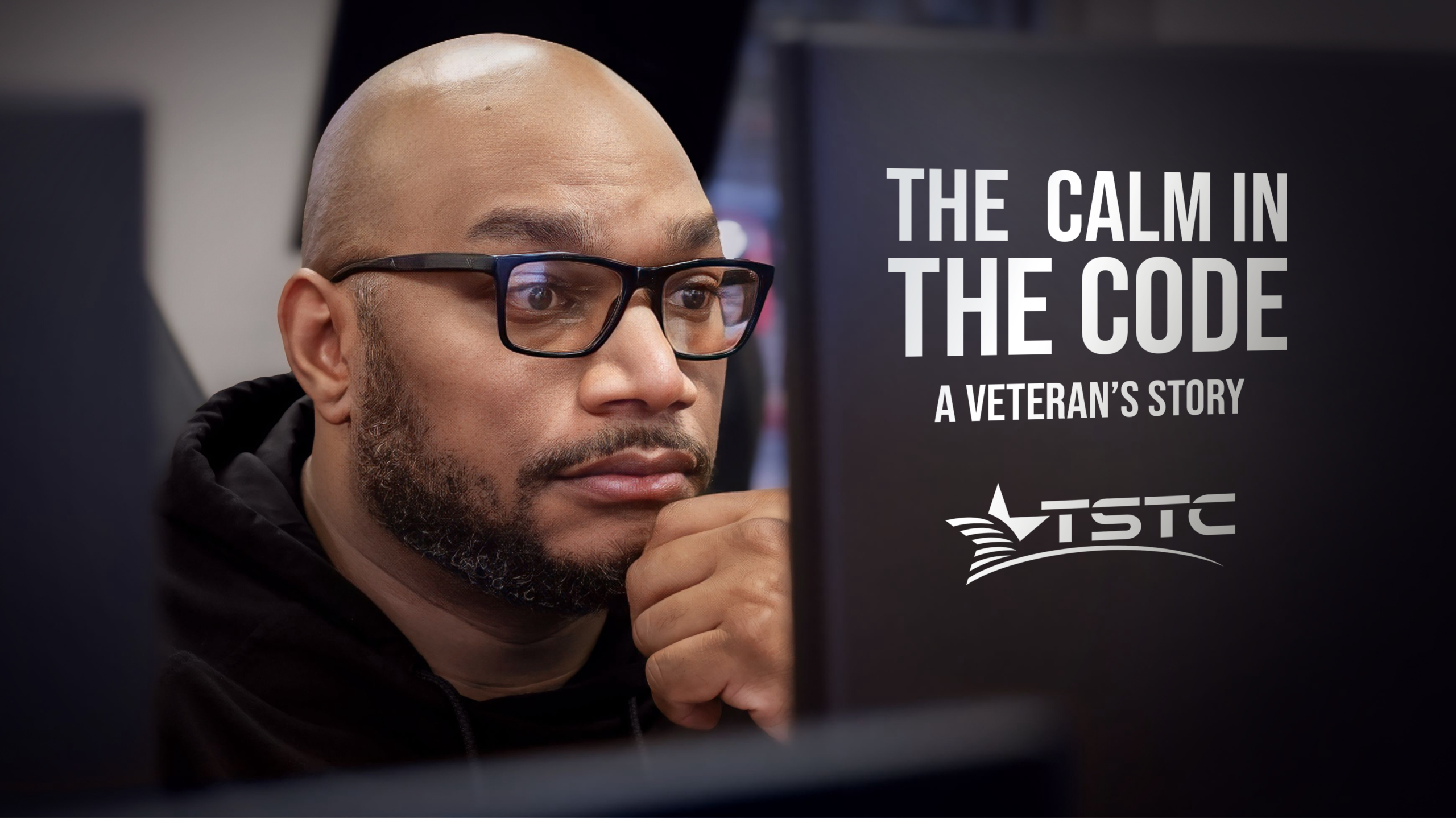
The Calm in the Code: How a Veteran Found His Future at TSTC
After facing life-or-death decisions overseas, Samuel Jacob is tackling a different kind of high-stakes challenge at Texas State Technical College. The Army veteran is channeling the discipline and composure forged in combat into a new career in cybersecurity — and building a future for his family.
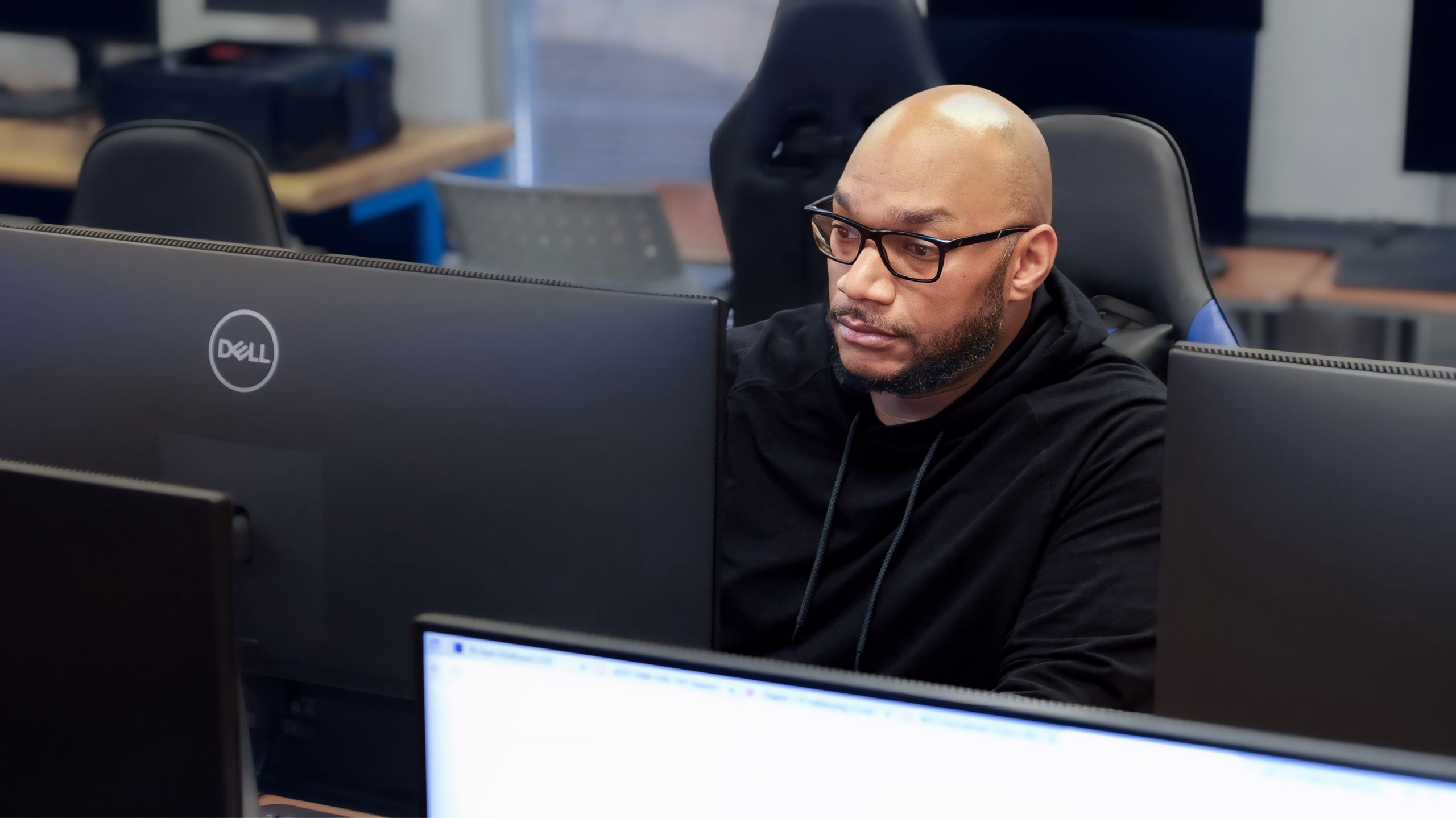
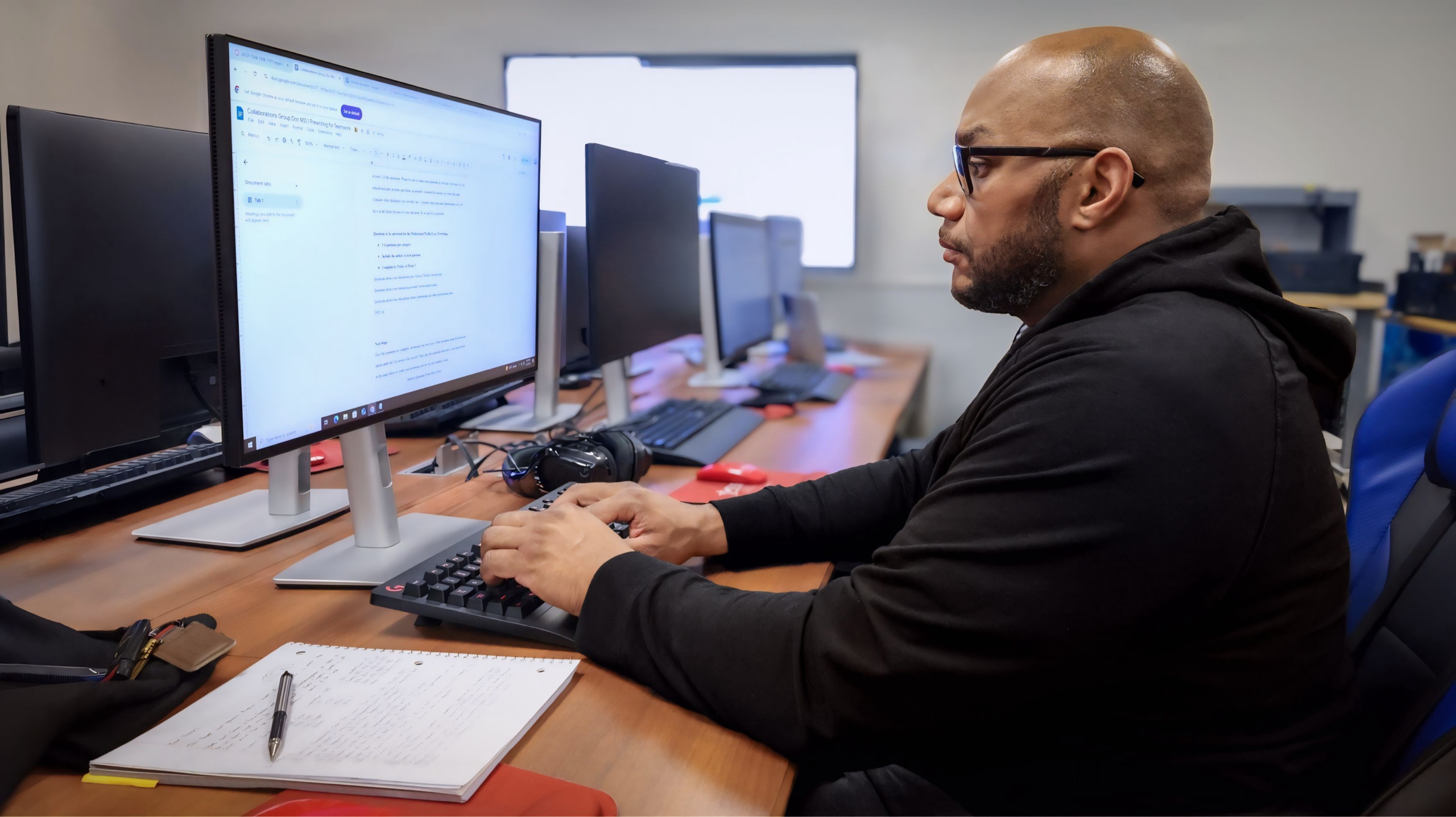
The rapid tapping of keyboards echoes through the computer lab at Texas State Technical College’s Williamson County campus. Samuel Jacob is honing his skills, looking to start a stable career in cybersecurity. He remains calm despite the pressure of a mastery test. It isn’t multiple-choice. It’s hands-on: finding problems, then fixing them.
His background had prepared him for this. The lab’s quiet focus pulls him back to another kind of pressure, the rumble of the vehicle he drove while deployed in Afghanistan. Samuel followed in his family’s footsteps, entering the military at 23.
When the Situation Turned
Long before Samuel sat in front of a computer in a TSTC lab, his hands were steady on a steering wheel, dust billowing off an Afghan road. Then something went wrong. An unexploded round came over a ridge line and struck a school used by Afghan soldiers.
“It didn’t explode,” Samuel said.
That didn’t make it safe. It made it uncertain.
“We had to get from one corner of the base to the far side,” Samuel said. “We were the first ones to make contact with what was going on over there.”
They were racing to the impact site to secure the area until Explosive Ordnance Disposal (EOD) arrived.
What was supposed to be a routine rotation turned muddy fast, like the dirt he was driving on.
Samuel’s instincts kicked in. All he could feel was the steering wheel in his hands. All he could hear were the directions and commands from the senior Air Force defender beside him. He focused on guiding his team safely across the base. His eyes bounced between the road and the speedometer, the number 65 miles per hour ingrained in his head.
“Focused. I wasn’t sweating,” Samuel said.
That moment became a blueprint: slow down, follow the process, stay calm.
When they arrived, Samuel stayed steady, but the concern didn’t lift. His team held the perimeter for about five hours, engines off, eyes scanning, waiting for EOD to render the unexploded round safe. The danger didn’t disappear just because it hadn’t detonated.
“That could have exploded right then and there,” Samuel said.
For five hours, they treated the silence like a countdown, holding position until the specialists could make the area safe.
They made it through, but the habit was what lasted. In chaos, he learned to slow down, follow the process, and follow the protocol, a mindset he carried home and into the life he built after the military.
Coming Home to a New Life
After Samuel returned from Afghanistan, he needed time to recover. He’d missed his family, especially his niece and nephew whom he was close to before he deployed.
He tried to make up for lost time, but he also had to do what he called “reset himself.”
“I had to come to terms with a lot of things that I put on the back burner because I had missions to do. I had soldiers to mentor,” Samuel said.
Back in civilian life, his first focus was figuring out who he was without the uniform. He didn’t know then that it would also lead him to his wife, someone who challenged him to see life differently. Instead of living by strict military standards, he learned to embrace a looser, more comfortable rhythm.
“She kind of completed what I was missing,” Samuel said. “She softened me up a little bit.”
Samuel and his wife married in November 2022. A year later, he once again experienced a major change in his life. He was going to become a dad.
With his military background, Samuel was always taught to control his feelings and assess the situation. That carried over into the birth of his son.
“I’m not saying I was emotionless,” Samuel said. “I just didn’t know how to place them yet.”
It wasn’t until his son turned one that the puzzle became a picture. He used that time to become the best dad he could be, and in the process, he rediscovered who he was.
The next step was finding a career that allowed him to support his family, one that offered stability and let him be present at home.
When Clippers Became Keyboards
At first, Samuel saw a steady future in a barbershop: clippers, a chair, and a familiar routine. On leave, he researched schools and licensing requirements. But while researching barber schools, another path kept appearing: TSTC’s Cybersecurity program. The more he read, the more it clicked. Barbering offered routine. Cybersecurity offered something he’d missed since leaving the military: complex problems with clear solutions.
“Coming from a mechanical background, I like troubleshooting things, because there’s always a solution for it,” Samuel said.
He applied to TSTC in early 2025. Once he was accepted, he felt the same quiet certainty he’d felt in Afghanistan: this was the right move.
On his first day of class, Samuel sat down at his computer, powered it on, and opened his first lesson plan. Within minutes, he felt consumed by a foreign language.
“I thought I knew a little bit about computers,” Samuel said. “I did know some things, but in a classroom setting, when they’re talking about different terminology, it feels like I’m learning a new language.”
He compares the learning curve to his child’s first year. Right now, he’s crawling. He’s working toward walking. By the time he graduates, he plans to be running.
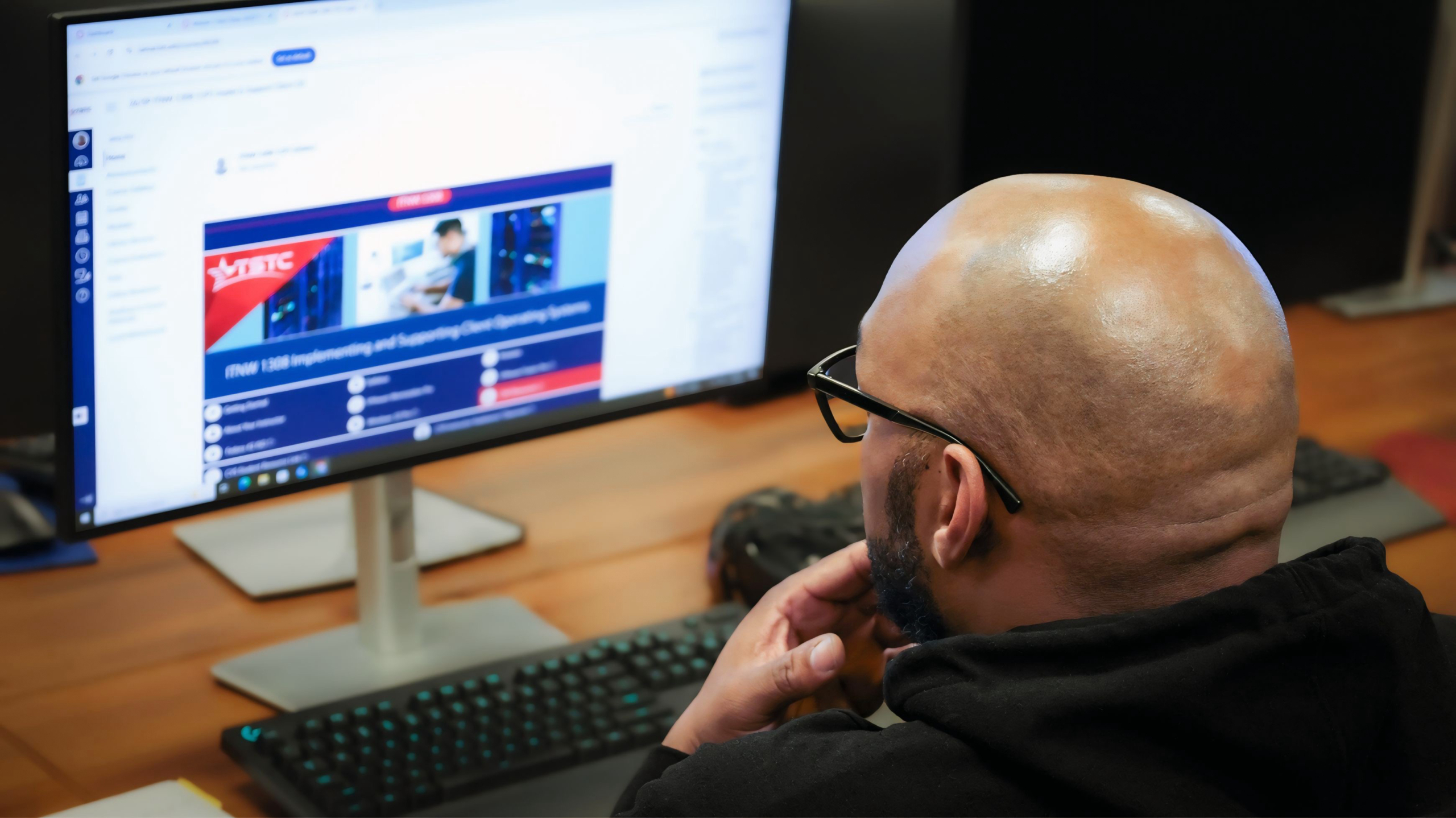
Samuel noticed a difference from the first day he walked into the lab. To stay on top of his work, he started studying from home. Then he had to troubleshoot his own computer when a required file wouldn’t run.
“I’m following directions,” Samuel said. “I was like, oh, so that’s how that works. That’s how you command your computer on this side. You follow the steps, it takes you up to a boot screen. I feel like I’m over here putting this computer together myself.”
“He’s able to take his past experience and apply it to lessons by retaining and analyzing information,” Stuart McLennan, a TSTC Cybersecurity instructor, said. “He can operate independently.”
Back in the computer lab, Samuel faces his first mastery test. The room is quiet except for the tapping of keyboards. He reads the scenario, breathes deeply, and begins troubleshooting methodically, just as he learned in the military.
“Just in a matter of three weeks, I’m on top of it,” Samuel said. “I feel more confident than when I started. I know I can do this.”
But when he submits the mastery, the results aren’t up to his standards. For a moment, disappointment flickers. Then he remembers his own words. He’s still in the crawling phase. The test isn’t a failure, but a checkpoint. He takes a breath, determined to keep moving forward.
Each challenge in the lab, including setbacks, is part of the process. Samuel hopes to take what he’s learning at TSTC and apply it with the Department of Defense, a career that would allow him to fully support his family.
The military taught Samuel to move forward under pressure, the same way he did behind the wheel in Afghanistan. He uses that same calm when his son needs him at home and when a line of code refuses to cooperate in the lab.
The road is now a screen; the steering wheel, a keyboard. But the mission remains the same: protect what matters and keep people safe.