

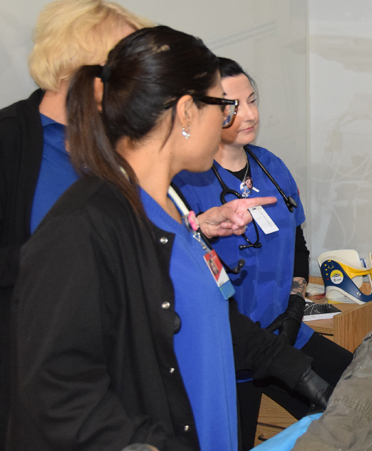
(ABILENE, Texas) – An emergency room can be a blur of chaos when a mass casualty event occurs.
That high-pressure environment is exactly what Texas State Technical College’s LVN to RN Transition Nursing students experienced during the recent spring semester’s extrication day exercise at the Industrial Technology Center in Abilene.
“We are finally getting some action,” said student Natalie Gonzalez. “I was nervous, but you are trained for days like this.”
Gonzalez, of Cisco, and her teammates compared the exercise to the HBO Max series “The Pitt,” which follows the day shift of a Pittsburgh hospital emergency room. Much like the characters on screen, the students were given very little information about the accident beforehand.
“All we knew was it was a catastrophe of some kind,” Gonzalez said.
John Young, a student from Abilene, worked the triage and treatment stations during the four-vehicle scenario. The simulation presented a wide spectrum of trauma, ranging from a victim with a rod impaled in his chest to another suffering from a panic attack.
“It is very important to know the person’s condition, so you know if they need immediate help or can wait a little longer,” Young said. “We also had to see which victims could not make it, so we did not waste valuable resources on a patient who would die.”
Both students noted that working with live “victims” — played by TSTC instructors and current Paramedic students — provided a level of realism that medical manikins cannot replicate.
“This is not something we typically do in the lab,” Young said.
While the scenario was intense, Gonzalez said her initial reaction was pure excitement.
“I just could not wait to get my hands dirty,” she said.
Mirroring the themes of “The Pitt,” Gonzalez was eager to see how the team would handle the unknown.
“I want to see if we react in a natural fashion or if we run around with our heads cut off,” she said.
As the scenario concluded, Gonzalez was smiling.
“Everything fell into place. No one was stepping over anyone,” she said. “It was exciting to see what we could do in a stressful situation.”
The “victims” also walked away with a newfound respect for their healthcare partners. Hunter Spohn, a paramedic student who played the victim with the rod in his chest, praised the nursing students’ composure.
“They jumped in there and got to work,” Spohn said. “I was screaming at them and making it stressful. They made sure the wound was treated and always checked my vitals.”
Student Elizabeth Hammons, who portrayed an upset victim whose sister died in the accident, noted the importance of the students’ bedside manner.
“They were there for me for both treatment and emotional support,” Hammons said. “The nurses showed a lot of compassion.”
The TSTC Emergency Medical Services and Nursing programs hold an extrication exercise each semester, allowing students to apply skills learned in the lab and clinicals to a simulated real-world disaster.
Registration for the summer and fall semesters is now underway at TSTC. For more information, visit TSTC.edu.