

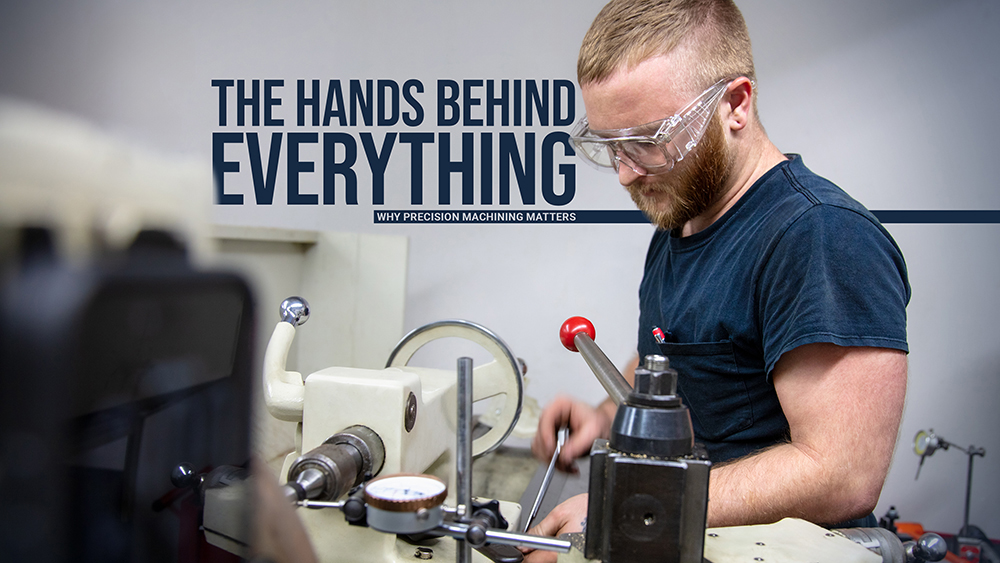
Masters of Precision: Why Machinists are Essential to Everyday Life
From smartphones and laptops to vehicles and HVAC systems, many of the products Texans rely on every day begin with a machinist. Machinists create the precision parts that keep industries moving, transforming raw materials into components used in manufacturing, aerospace, energy, healthcare and countless other fields.
But what does a machinist actually do?
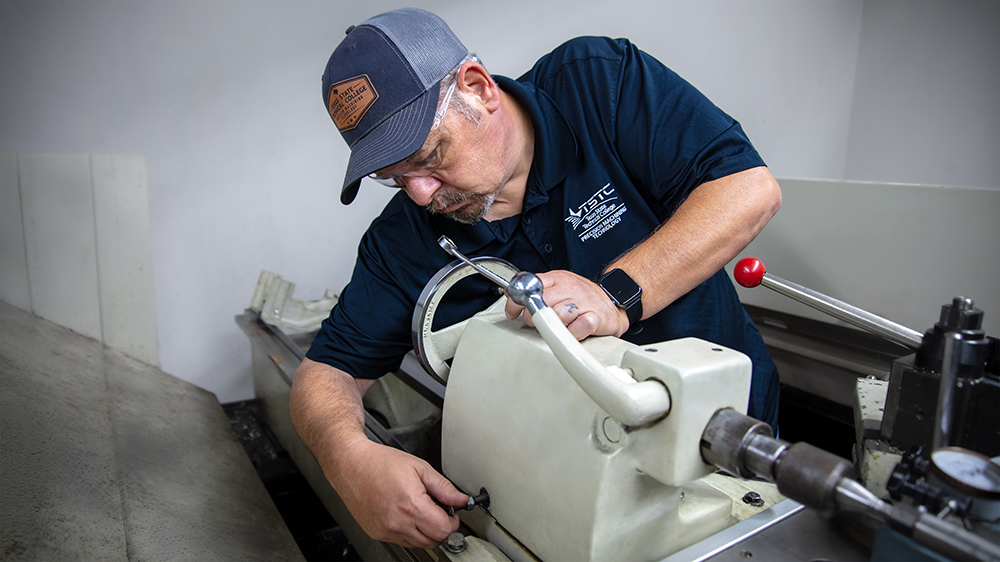
“A machinist takes amazing pieces of metal with questionable drawings and makes parts that are used every day,” said Daniel Nixon, a Precision Machining instructor at Texas State Technical College. “Shoes, utensils that we eat with, somebody had to make the mold, car parts, airplane parts; we truly have our hands in just about everything that is produced in this country and around the world.”
According to onetonline.org, computer numerically controlled (CNC) tool programmers earn a median salary of $66,750 a year in Texas, where the number of these jobs was projected to grow 23% by the year 2032.
However, that number may further increase as Texas faces a shortage of machinists.
“In my opinion, if we did not replace the machinists — not just in Texas but worldwide — it could, theoretically, shut the world down,” Daniel said.
To combat the problem, TSTC offers the Precision Machining program at its Fort Bend County, Harlingen, Marshall, North Texas, Waco and Williamson County campuses.
Alternatives Do Not Equal High Quality
TSTC works with industry partners to ensure students are educated according to workplace standards. Several of these businesses are being affected by the machinist shortage.
Matt Florczykowski, the general manager and sales manager for Allen’s Electric Motor Services said every single part his company handles is unique, given the wide variety of industries that require electric motors — from power plants to pulp and paper.
“Every repair job that comes through our shop goes to the machining shop; it’s a highly important piece,” he said.
Matt said that if Allen’s is lacking in machinists, they have to resort to outsourcing, a detriment to the company in more ways than one.
“Anytime I have to outsource something, I lose some ability to maintain certain quality control procedures that we expect,” he said. “It would cost us profitability, it would cost us time, the logistics involved in transporting, it would be a major bottleneck for us.”
While some businesses seek to solve the shortage with automated machinery, Henel Nabi, the vice president of equipment utilization and projects for Martin Sprocket and Gear, said this presents its own problems.
“If small shops decide to invest in automation, then their product becomes very expensive,” he said. “Our MRO (maintenance, repair and operations) business is mostly custom; we go in, measure it, and make it custom made. Automation cannot do that today.”
Both companies are involved with one or more TSTC campuses. Representatives said the college’s hands-on approach offers the students an essential foundation in machining that they can build upon in those they hire.
“It’s imperative for us to invest in the future because our business and our livelihood depend on having another generation of people coming up,” Matt said. “We have an aging workforce.”
Though automation and artificial intelligence continue to advance, Henel made it clear that TSTC’s Precision Machining graduates should feel secure.
“The only way you can get rid of machinists is if you have additive manufacturing totally evolved and connected to someone’s brain,” Henel said. “If I could tell the students something, it’s that, no matter what happens in the world, how evolved we get, you will always need a guy that knows how to make the dream happen.”
And many of the program’s students and graduates have built the expertise needed to do just that job.
Making a Splash in Machining
Like any 16-year-old with a four-wheeler, Clay Carter, of Kilgore, had big plans for adventure. Watching it sink in the water after a ride gone wrong was definitely not on the list.
Rather than tell his son to count his losses, Clay’s dad fished out the remains and hauled the ill-fated vehicle and his son to his uncle, a helicopter mechanic, for a lesson in repairs. Two weeks of learning from his uncle set Clay’s future in stone.
“That’s when I first realized that, when you break something like this, it can be rebuilt,” Clay said. “There was a Napa Auto Parts down there (in Conroe) with a machine shop in the back room for building engines, and that was my first exposure to machining. I just knew that’s where I wanted to be.”
Graduating from TSTC’s Precision Machining program was just the start of Clay’s legacy. He spent 21 years making a name for himself as a machinist, not only at East Texas businesses, but through his own; Carter Fab and Machine, LLC, a custom fabrication shop for vehicles and model cars.
Clay has seen the impact a machinist shortage can have, especially on family-oriented people like him.
“If there’s not enough people in the workforce, you’re working 60-80 hours a week nonstop,” he said. “It’s not good for a family; even though you’ve got the money, you get pulled away.”
Clay said he feels the public does not recognize the possibilities of machining. He compared the process to building with LEGOs, as both give someone the ability to create anything they want. But unlike play time, machining provides a good salary and an abundance of jobs.
“If you want to go into a work field and you think maybe there’s too many of these people, I promise you, there are not enough machinists,” he said.
Though retired now, Clay still occasionally does work for his previous clients. He still looks for any opportunity to use his skills for home repairs or special projects.
“I’m fascinated with it and I will be forever,” he said. “I wish more people were, because it’s such a cool thing to be able to make anything you want anytime you want.”
An Education Makes a Career
Ever seen those movies where a big shot says, ‘hey kid, you want a real gig?’ Well, that’s exactly what happened to Caleb Bush, of Waskom. With one conversation he went from working in a restaurant to working in a machine shop.
Caleb developed his skills as a CNC operator for over four years before enrolling in the Precision Machining program at TSTC’s Marshall campus. He was confident in his skills, but not having a degree made it difficult to move up in the workforce.
“I’m going to get an education, get some hands-on training while I’m at it, and see where I can go from there,” he said.
In machining, mismeasuring can damage a part or even the machine itself. Caleb said his career and his education have turned him into something of a perfectionist, even as he is able to produce parts at a quicker pace than before. He knows customers do not want something that looks rushed, including machined parts, and he takes that seriously.
“I take a lot of pride and responsibility in making sure that the first few parts consistently look perfect,” he said.
Despite the complexity of the pieces produced by machinists, Caleb said the work is not too hard for anyone capable of basic math. Like Clay, Caleb’s career has left him sure that the work never stops for a machinist, ensuring a multitude of job opportunities for future Precision Machining students and graduates.
“There’s always work to be done in this industry,” he said. “Everything that you see in the world, in some shape or form, has come off of the CNC machine.”