

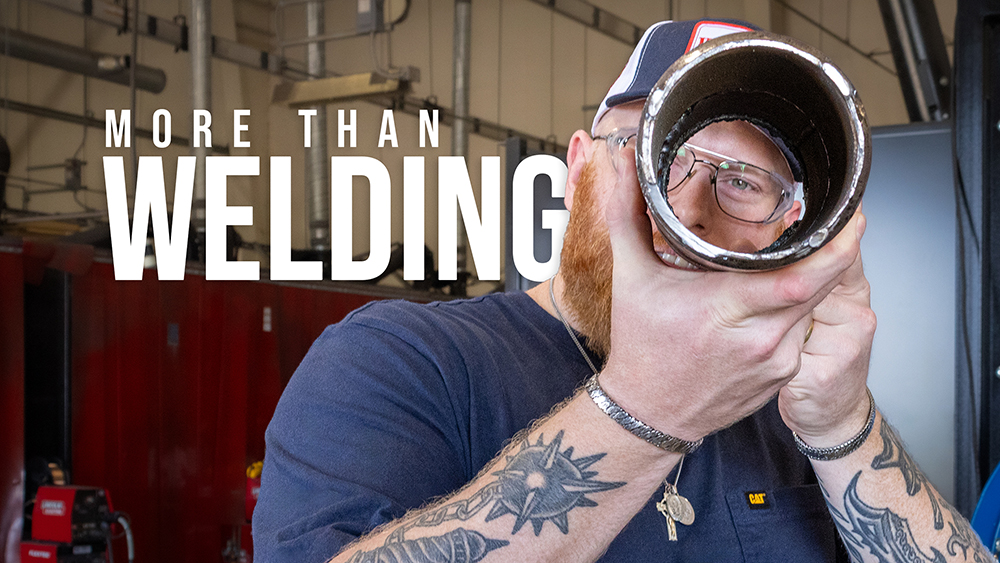
Wearing the Patch with Pride: Raleigh Derks Reflects on 11 Years of Teaching at TSTC
The sensory overload hit Raleigh Derks all at once. The lights were bright and the music was blaring, but for a moment, the room felt silent. He stood in his graduation gown, a stark contrast to the calloused hands of a man who had spent years behind a welding hood, watching the students he mentored walk across the stage.
The Weight of the Handshake
Among them was a student carrying a burden heavier than any diploma could measure: near the end of the semester at Texas State Technical College, his mother had passed away.
“Everybody loves their mom,” Raleigh recalled. “So, you know, my heart went out to him. I just told him, ‘I have no idea what you’re going through, I haven’t experienced that yet, so I can’t even imagine.’”
Raleigh couldn’t fix the grief, but he could offer time, extra booth hours and grace. The student didn’t drop out. He pushed through, finished the work and finally reached the stage. When their hands met for a proud, firm handshake, the journey came full circle.
“That’s what you do it for as an instructor,” Raleigh said.
Beyond the Booth
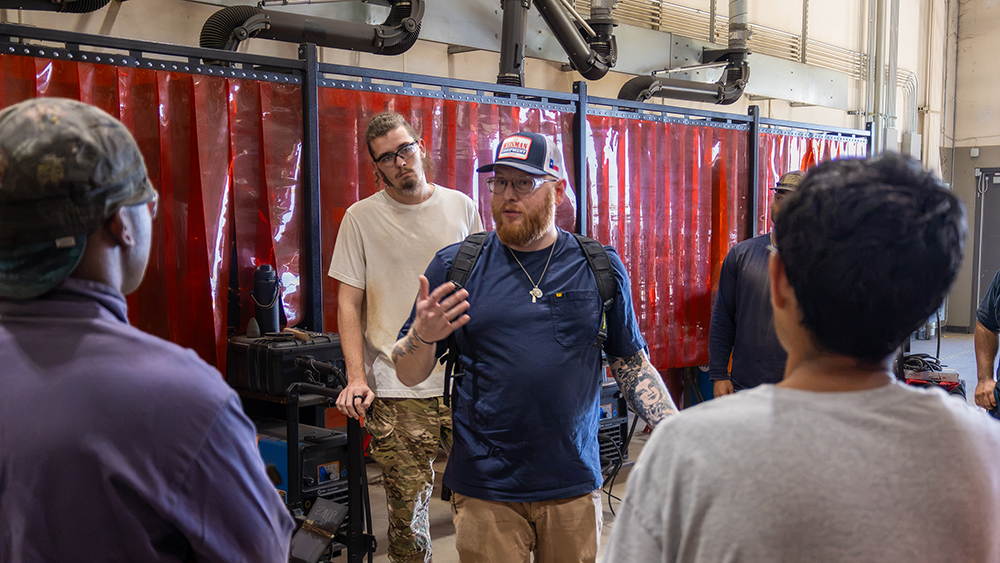
Now, after 11 years spent inside soot-stained welding booths, Raleigh is hanging up his helmet. Effective September 1st, he is transitioning out of the classroom and into a statewide role as the Senior Manager of Welding, a move that shifts his daily focus from individual arc welds to high-level administrative strategy.
While stepping away from direct instruction brings a bittersweet pull, Raleigh views the promotion as an opportunity to broaden his impact across TSTC.
“I want to be fair across all campuses,” Raleigh explains. “I tell my students you know you’re at a great place to work whenever you’re in a fair environment.”
Much like his students striving for the perfect weld, Raleigh is actively leaning into the challenge of this next chapter. Leaving the daily rhythm of the shop floor marks a major shift, but his core objective remains unchanged: building a well-equipped, fair environment where both instructors and students can thrive.
For Raleigh, building that culture starts with stepping into a mentorship role for the teachers themselves.
“I see it as a bit more of a ‘train-the-trainer’ approach, so to speak, where I take my experiences and become a resource and a contact point for instructors,” Raleigh reflected. “Whether they’ve been at it a while or they’re brand new, it’s my opportunity to share what I’ve learned and the knowledge I’ve gained through experiences and mistakes.”
Striking the First Arc
Growing up, Raleigh naturally assumed his future lay under the hood of a car. His uncle was a drag racer and auto mechanic, and for a long time, Raleigh thought the roar of engines, burning rubber and grease-stained knuckles were his calling.
He enrolled in auto tech classes at a tech academy in his hometown of Mansfield, Texas, only to quickly discover that a life in the shop was his worst nightmare.
“Turns out I hate working on cars,” Raleigh admitted with candid distaste. “I can’t stand it. I think it’s the worst thing in the world. I do basic maintenance on my truck, but if there’s any work that needs to be done, I’m not going to be happy about it.”
That misstep, however, pointed him toward his true path. Noticing his mechanical aptitude, his high school instructor, Mr. Curlee, asked him a simple question: “Have you ever thought about welding?”
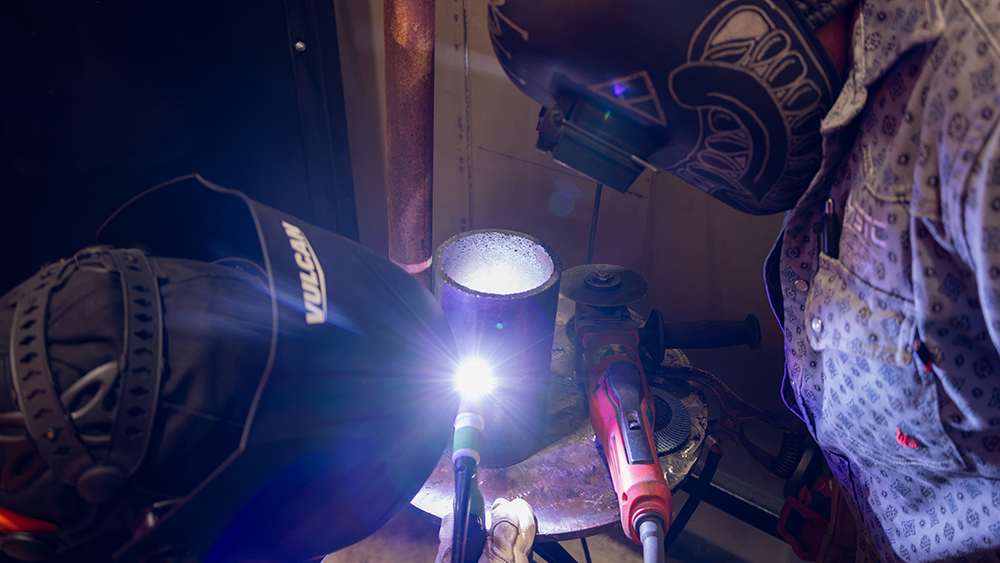
Mr. Curlee gave him a brief demonstration, put a torch in his hand, and let him strike his first arc. Turns out, Raleigh was a natural.
“I’m able to see something and replicate it, which, as it turns out, is what welding is,” Raleigh explained. “You see somebody do it once, and if you can replicate that mechanical motion, you’re good.”
After examining that very first weld, Mr. Curlee looked at the teenager and made a prediction that would shape the rest of his life: it would be a missed opportunity if he didn’t do this professionally.
More Than the Metal
Raleigh’s path was starting to tack together, leading him straight to Texas State Technical College in Waco. It was there that the instructor who gave him his initial campus tour took him under his wing.
While Raleigh found all of his professors to be fair and encouraging, he formed a deep, lasting connection with metallurgy instructor Del Bullock. It wasn’t a standard teacher-student dynamic. Del held Raleigh to a rigorous standard.
“He gave me a hard time, which I responded well to,” Raleigh recalled with a smile. “When I became an instructor, I had somebody I wanted to be like.”
After graduating and working in the industry, Raleigh decided to follow in his mentor’s footsteps and return to TSTC as an instructor. By his own admission, however, he didn’t enter the classroom for entirely selfless reasons. Initially, he viewed the teaching position as a personal training ground, a chance to get paid while logging extra hours in the lab to perfect his own craft.
“I thought it’d be a great place to practice being an instructor,” Raleigh reflected. “I went into the teaching role like, ‘I’m going to get really good at this.’ Starting out, it was like, ‘I’m going to get to go work in the gym, so to speak, lift the weights and get stronger in welding.’”
That self-focused motivation didn’t last long. A switch flipped after his very first semester in front of a class, when he realized that being an educator required far more than demonstrating technique behind a dark visor.
“When you’re a welding instructor, you’re much more than just a person that knows a lot about welding,” Raleigh said. “Because life doesn’t stop whenever you become a student. So you have to be, I would say, a counselor of sorts… You have to be very human.”
That human-centered approach translated directly into how Raleigh gave technical feedback on the shop floor. Alexander Zantop, an associate degree student in Raleigh’s welding technology course, experienced that standard firsthand in the booth.
“He’s blunt, straightforward, and a lot more thorough,” Zantop said. “With Raleigh, even if your first weld out is perfect, he’ll have you go do it two or three more times just to make sure you can repeat that perfection.”
Rather than forcing every student into a rigid mold, Raleigh customized his instruction to fit each student’s natural strengths.
“Instead of just telling you, ‘Hey, this is how it’s generally done,’ he’ll tell you, ‘This is what you’re doing, and this is what you could change,’” Zantop noted. “Even with that, you don’t have to overhaul everything, you can just change one small part and use what you’re already doing to your advantage.”
For Raleigh, watching those individual adjustments lead to breakthroughs brought a sense of pride far deeper than laying down any perfect dime-stack weld.
“I did get really good at welding, don’t get me wrong,” Raleigh said. “But seeing the students succeed was the best part.”
Putting on the Patch
Over the past 11 years, Raleigh’s calling as an educator took him across three different TSTC campuses: seven years in Waco, three in Marshall and a final year in New Braunfels. Though his new statewide duties will require extensive travel, he will remain rooted in New Braunfels, working out of the campus office a couple of days a week.
Wherever his new responsibilities take him, he carries more than a decade of classroom memories and shop floor wisdom with him.
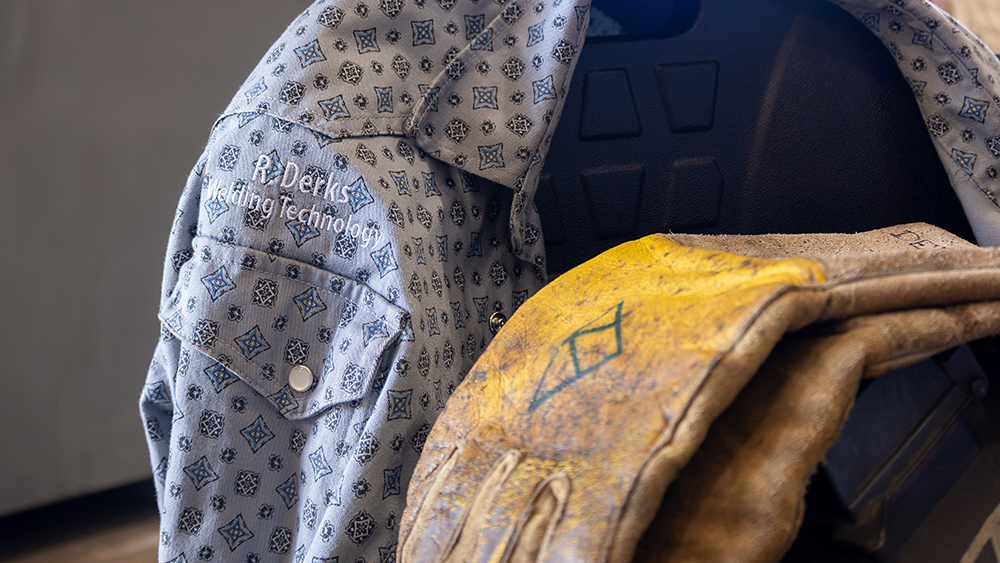
“Being an instructor at TSTC is like a patch that you sew on your shirt,” Raleigh reflected. “It’s an ID. It’s an identity, and I wear it with pride.”
Despite stepping into a higher executive role, Raleigh has no intention of changing his core approach. He views leadership through a lens of service, always asking how he can be part of the solution, how he can lighten the load for others and how he can support the instructors on the front lines.
While stepping away from direct instruction is a major shift, the students he leaves behind recognize the impact of his move.
“Honestly, I feel for the students coming after losing out on such a great instructor, but I’m happy for him moving on with his career,” Zantop said.
While Raleigh may no longer be standing side-by-side with students in the welding lab each day, his administrative decisions will directly shape their daily experience across the state.
“I may not be in the booth with them welding, but I know that my role in what I’m doing is helping them be more successful while they’re here at TSTC,” Raleigh said.
It is a quiet, behind-the-scenes effort with a single, clear objective: ensuring that every future student who enters a TSTC welding shop gets the opportunity to work hard, overcome their own challenges, and eventually walk across that stage, where the music is blaring, the stage lights are shining, and a firm, calloused handshake marks the start of a brand-new life.